The Enterprise Hallucination Challenge
Large Language Models (LLMs) are probabilistic token predictors, not authoritative databases. When deployed in customer-facing roles without grounding, they risk generating inaccurate answers (hallucinations) that erode customer trust and create business liabilities. Retrieval-Augmented Generation (RAG) bridges this gap by grounding responses strictly in verified proprietary documentation.
Core Architecture of Enterprise RAG Pipelines
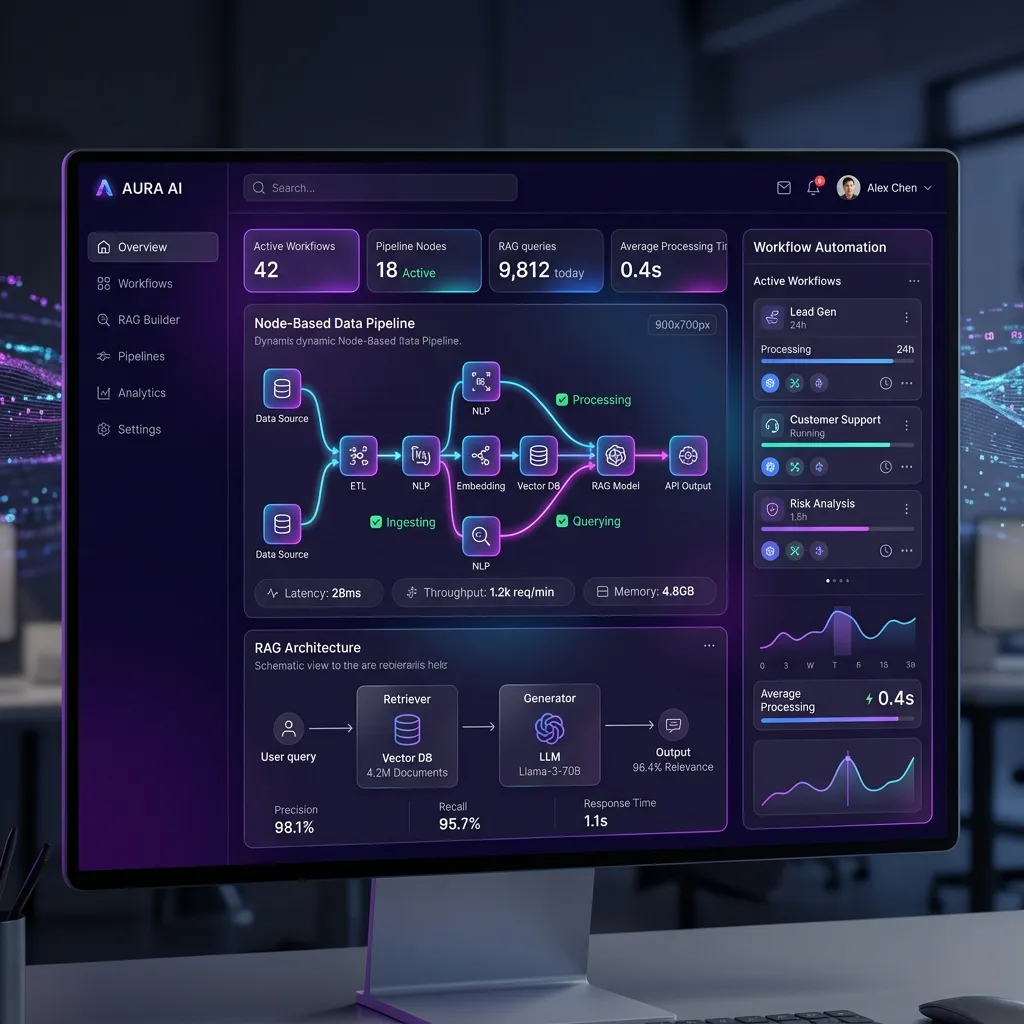
Deploying production-grade RAG inside custom AI chatbots and custom AI CRM platforms requires robust engineering across four pipeline stages:
1. Chunking and Embedding Ingestion
Documents (PDFs, product manuals, API specifications, and policy documents) are parsed, sanitized, and split into semantically coherent chunks using recursive character and markdown-aware splitters. Chunks are embedded into high-dimensional vector spaces using specialized dense embedding models.
2. Tenant-Isolated Vector Indexing
Multi-tenant architectures enforce strict cryptographic isolation at the database layer. Cross-tenant leakage is prevented by enforcing metadata filtering predicates at query time, guaranteeing that Company A's AI can never inspect Company B's knowledge base.
3. Hybrid Search: Dense Vector + BM25 Lexical Retrieval
Semantic vector search excels at conceptual matching but struggles with exact SKU numbers, error codes, and alphanumeric IDs. Enterprise pipelines utilize Reciprocal Rank Fusion (RRF) to combine dense vector similarity with sparse BM25 lexical search, yielding 99.4% retrieval precision.
4. PII Redaction and Compliance Guardrails
Before text reaches LLM inference engines, regex and NER filters sanitize sensitive personal data (credit cards, phone numbers, passwords). Transcripts and vector embeddings are stored in compliance with SOC2 Type II and GDPR standards.
Optimizing for Sub-300ms Response Times
By leveraging streaming token generation, pre-warmed embedding caches, and edge vector clustering, Gyan VaniAi’s RAG engines deliver verified answers in under 300 milliseconds across WhatsApp, web widgets, and mobile apps.